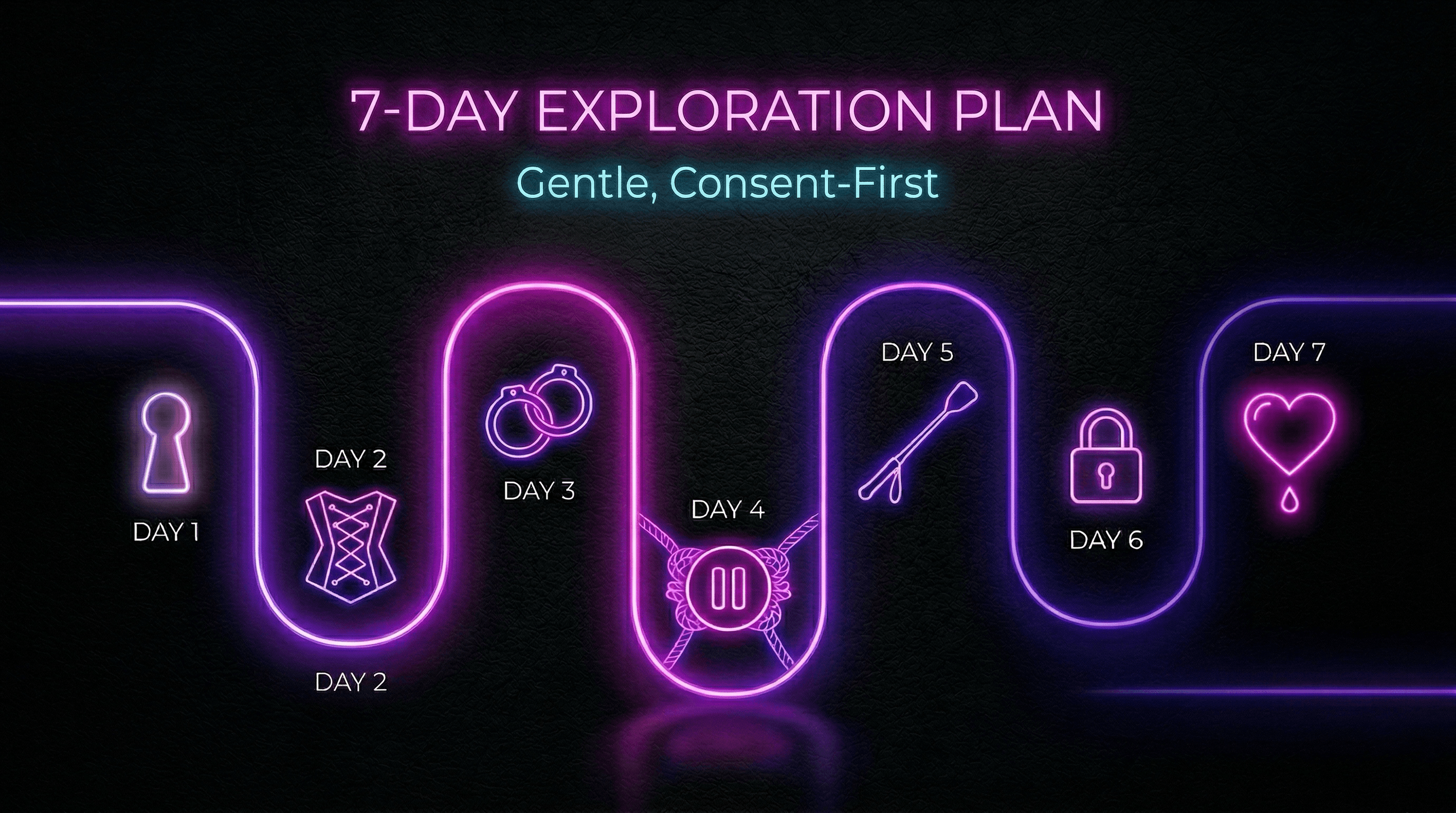
Roleplay doesn’t have to be theatrical, “in character,” or intense. For most people, the best version is small: a playful frame, a clear “yes/no/maybe,” and permission to laugh if it gets weird. The goal isn’t to perform perfectly—it’s to create a shared container where you can explore novelty while staying emotionally safe.
This guide keeps everything PG-13 and beginner-friendly. You’ll get five starter formats, a copyable two-sentence setup you can use tonight, a pacing ladder (start → build → stop), and scripts for when awkwardness shows up—because it usually does, and that’s normal.
1) TL;DR
- Roleplay works best when it’s low stakes and opt-in, not a surprise performance.
- Treat it like a game with rules, not an audition.
- Start with safe, familiar settings (meet-cute, mystery stranger, “soft” authority dynamic) and keep details minimal.
- Use the two-sentence setup: (1) the scene, (2) the permission.
- Follow the pacing ladder: start small, build slowly, stop cleanly.
- Awkwardness isn’t failure—it’s a signal to pause, reset, or simplify.
2) Why roleplay works (psychological safety, novelty)
Psychological safety: “It’s not me, it’s the scenario”
One reason roleplay feels freeing is that it separates identity from behavior. You can try a vibe—confident, shy, mysterious, bold—without making it a permanent label. That distance reduces self-consciousness and makes it easier to communicate.
Roleplay can also make consent clearer. When the “scene” is defined, it’s natural to ask:
- “Is this okay?”
- “Do you want to keep going?”
- “Want to switch roles?”
Those questions feel less like a buzzkill and more like part of the game.
Novelty: your brain likes “new, but safe”
Novelty adds spark, but your nervous system still wants predictability. Beginner roleplay works when it’s new enough to be interesting and structured enough to feel secure.
Think of it like traveling:
- You don’t start with “move to a new country tomorrow.”
- You start with “try a new café with a friend.”
Roleplay is the same. Start with something that feels playful and familiar, then expand.
3) 5 starter formats (PG-13, non-explicit)
These formats are designed to reduce pressure. Each comes with a “why it works” and a simple prompt. Keep it light: suggestive is fine; explicit is not required.
1) The Meet-Cute
What it is: You’re two people who just met in a charming, low-stakes situation.
Why it works: It’s familiar, sweet, and easy to improvise.
Prompt: “You’re ordering at a coffee shop and I accidentally take your drink.”
Add-on options (choose one):
- “You pretend to be annoyed, but you’re smiling.”
- “We both realize we’re reading the same book.”
- “We end up sharing a table because it’s crowded.”
2) The Mystery Stranger
What it is: One of you is unknown—new in town, passing through, or wearing a “disguise” like a different name.
Why it works: The anonymity lowers self-consciousness and invites playful questions.
Prompt: “You sit next to me at a hotel bar and introduce yourself as ‘Alex’—but you won’t say more.”
Add-on options:
- “I’m curious and try to guess your story.”
- “You give me a ‘mission’ that’s harmless and fun.”
- “We keep it PG: just banter, charm, and suspense.”
3) The Soft Power Dynamic (gentle authority)
What it is: A mild, respectful authority vibe—coach/student, host/guest, librarian/patron—without intimidation.
Why it works: It adds structure (“who leads?”) while staying safe and playful.
Prompt: “You’re the strict-but-kind librarian and I’m whispering too loud.”
Boundaries to keep it soft:
- No humiliation.
- No harsh commands.
- Keep it playful: “Let’s do this properly,” not “Do what I say.”
4) The Compliment Challenge
What it is: A game where you “compete” to give each other confidence.
Why it works: It’s intimacy-forward without being intense.
Prompt: “We’re at a party and dare each other to give the boldest compliment we can—quietly.”
Rules:
- Compliments must be specific.
- Either person can say “switch topic” anytime.
- If someone blushes too hard, you slow down.
5) The Secret-Message Game
What it is: You pretend you can only communicate in coded notes or short “missions.”
Why it works: It lowers the burden to improvise and creates a fun structure.
Prompt: “We’re spies. You slip me a note with my next instruction: ‘Smile like you know a secret.’”
Add-on options:
- “We trade short missions back and forth.”
- “We keep it wholesome: a wink, a compliment, a ‘report back.’”
- “We end the scene with a ‘mission accomplished’ high five.”
4) The “two-sentence setup” formula (copyable templates)
The biggest barrier to roleplay is the start. People overthink: What voice do I use? What if I’m cringe? The solution is to make it small and clear.
The formula
- Scene sentence: Where are we, and who are we right now?
- Permission sentence: What’s the tone and the safety rule?
That’s it.
Copyable templates (fill-in-the-blank)
- “Let’s pretend we’re [two roles] in [simple setting]. If either of us feels awkward, we can pause and laugh, then reset.”
- “Quick scene: [meet-cute premise]. Keep it PG-13 and we’ll check in after two minutes.”
- “I want to try a tiny roleplay: [mystery stranger]. You can say ‘yellow’ to slow down or ‘red’ to stop—no explanations needed.”
- “Let’s do a two-minute version: [soft power dynamic]. The goal is banter, not perfection.”
- “We’ll keep this simple: [game format]. If it works, we continue; if not, we switch to normal conversation.”
Ready-to-use examples
- “Let’s pretend we just met at a coffee shop. Keep it cute and flirty, and if it feels awkward we can laugh and restart.”
- “Quick scene: you’re a mysterious stranger on a train. PG-13 only, and we’ll check in after two minutes.”
- “Tiny roleplay: you’re the confident host and I’m the charming guest. If either of us says ‘pause,’ we drop the scene immediately.”
5) Pacing ladder (start → build → stop)
A common mistake is jumping straight to “big intensity.” Beginners do better with a ladder. Each rung is optional.
Rung 1: Start (10–60 seconds)
Goal: establish the frame, not the plot.
- Use names: “Call me ‘Jamie’ for this.”
- One setting detail: “It’s raining outside.”
- One tone agreement: “Playful, not serious.”
Micro-check-in:
“Still good?” / “Want to keep going?”
Rung 2: Build (1–5 minutes)
Goal: add one layer at a time.
Pick one:
- More dialogue (banter, teasing)
- More stakes (a harmless “mission”)
- More closeness (compliments, lingering eye contact in the scene)
Keep it easy to steer:
- “Can we keep it slower?”
- “Switch roles?”
- “Let’s make it sillier.”
Rung 3: Peak (brief, optional)
Goal: a small “moment,” not a marathon.
Examples:
- A confident line.
- A reveal (“I’m not who you think I am.”)
- A playful “rule” (“You have to guess my secret.”)
If you feel nerves rise: drop down a rung. That’s success, not failure.
Rung 4: Stop (clean ending)
A clean ending prevents emotional whiplash.
Use a closing line:
- “Scene end.”
- “Mission accomplished.”
- “Cut.”
Then do a post-scene check-in:
- “What part felt fun?”
- “What part felt awkward?”
- “Do you want to try again, tweak it, or stop for tonight?”
Stopping well is what makes starting easier next time.
6) What to do if you feel awkward (scripts)
Awkwardness usually means one of three things:
- Too much pressure (performance anxiety)
- Too many details (cognitive load)
- Unclear consent (uncertainty)
Here are scripts you can use in real time.
When you want to slow down
- “Pause—this is fun, I just want to go slower.”
- “Can we simplify the scene? One sentence at a time.”
- “Let’s keep it playful and short.”
When you want to reset without making it a big deal
- “I’m getting a little self-conscious. Can we laugh for a second and restart?”
- “Time-out. Same scene, but lighter.”
- “Let’s rewind: we’re back at the beginning.”
When you want to stop kindly
- “I’m not feeling this right now. I’d rather stop—no issues, just not my vibe.”
- “Can we end the scene? I’m good, I just want to switch back to normal.”
- “Cut. Thank you—let’s debrief for a minute.”
When you want more clarity about consent
- “Before we continue, what’s a clear yes for you here?”
- “Any ‘no-go’ topics for this scene?”
- “Do you want me to lead, follow, or trade off?”
When it turns silly (and you’re worried that “ruins it”)
Silliness is not failure. For many couples, it’s the doorway.
- “Okay, we’re laughing—good sign. Let’s keep it cute and continue.”
- “This is adorable. Want to keep going or restart more seriously?”
- “Same vibe, but slower.”
When one person freezes
If you notice your partner gets quiet, don’t push. Offer options.
- “Want a prompt, or should I take the lead for 30 seconds?”
- “We can switch to the compliment game instead.”
- “We can stop. No pressure.”
7) Checklist + FAQ
Quick checklist: beginner roleplay that doesn’t feel weird
- [ ] We chose a PG-13 starter format (meet-cute, mystery stranger, etc.)
- [ ] We agreed on a time limit (2–10 minutes)
- [ ] We used the two-sentence setup (scene + permission)
- [ ] We set a pause/stop word or phrase (“pause,” “yellow/red,” “cut”)
- [ ] We started with one detail, not a full script
- [ ] We did one check-in early (“Still good?”)
- [ ] We ended with a clean close (“scene end”) and a debrief
FAQ (3 questions)
1) What if roleplay feels “cringe” to me?
That’s common. Treat it like trying a new hobby: the first attempt is awkward because it’s new. Start smaller—use a “game” format (compliment challenge or secret-message missions) rather than full characters.
2) Do we need accents, outfits, or a big story?
No. Those can be fun later, but they’re optional. Beginners do best with minimal props: a new name, a simple setting, and a clear tone agreement.
3) How do we keep it safe and consent-first without killing the vibe?
Build consent into the structure: short time limits, a pause word, and quick check-ins. When it’s normalized, it feels smooth—not clinical.
8) End CTA
Roleplay gets easier when you’re not guessing. A quick preference map can help you find what feels playful, what’s a “maybe,” and what’s a “no”—before you start.