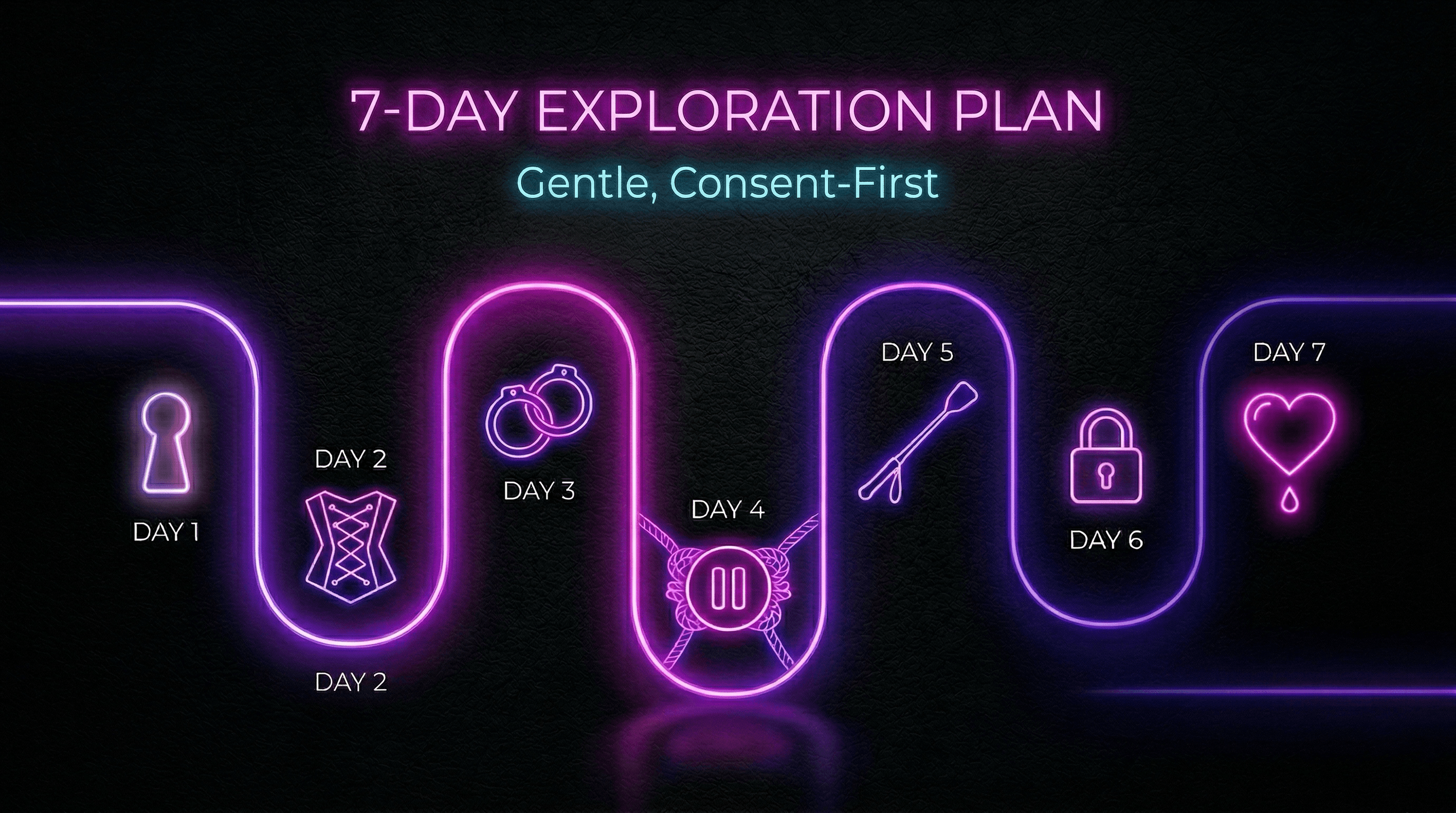
If you’re curious but not “high intent,” you’re exactly who this plan is for. You don’t need to have a big goal, a label, or a checklist of experiences. You just need a way to explore that feels safe, optional, and reversible.
This 7-day plan is intentionally lightweight:
- 5–10 minutes per day
- One micro-action (tiny, low-stakes)
- One reflection prompt (to notice what’s true for you)
- Clear stop-if-uncomfortable language—because stopping is progress, not failure
It’s also privacy-first. Wherever possible, keep notes local-first (e.g., in a notes app, offline journal, or a private file). Share only what you want, when you want.
TL;DR
- This is a gentle 7-day exploration habit, not a “challenge.”
- Day 1: Take the BDSM Archetype Quiz (your primary map).
- Day 2: Do a quick preference-mapping step (with an optional tool link inside Day 2 only).
- Every day includes a micro-action + reflection prompt + stop rule.
- If you feel pressured, anxious, or “icky,” pause. Curiosity works best when consent is real—yours included.
Your two rules for the week
1) Consent is pacing
Consent isn’t just “yes/no.” It’s also how fast, how intense, and how often. If you’re exploring solo, consent still applies: you’re practicing listening to your own signals.
2) Discomfort is data, not a deadline
You don’t need to “push through.” If something feels off, your job is to notice, name, and adjust (or stop). That’s not being cautious; that’s being skilled.
Before you begin: the 30-second baseline
Micro-action (30 seconds): Rate your current comfort level from 1–10.
Reflection prompt: “What would make this feel one point safer today?”
Stop rule: If you’re at 4/10 or lower, do Day 1 only and treat the rest of the week as optional.
The 7-Day Plan
Day 1 — Get a map (without labeling yourself)
Micro-action (5–10 minutes): Take the BDSM Archetype Quiz and skim your results once—no deep analysis.
- Treat the result as a starting hypothesis, not an identity.
- Circle (mentally or in notes) one phrase that feels “true enough.”
Reflection prompt:
- “What felt validating?”
- “What felt like a ‘no’—and can I respect that no without overthinking it?”
Stop if uncomfortable:
If any result sparks shame or alarm, pause and write: “I’m allowed to be curious at my own pace.” Then close it. That’s a complete Day 1.
Day 2 — Name preferences in plain language (gentle sorting)
Today is about turning vague curiosity into clear, low-pressure language. You are not committing to anything. You are just sorting.
Micro-action (5 minutes): Create three lists in your notes:
- Yes / Interested
- Maybe / Not sure
- No / Not for me
Add 3 items total (not per list—total). Use plain language like “being guided,” “more structure,” “more playfulness,” “more calm,” “more intensity,” “more control,” “less surprise,” etc. Keep it general and PG-13.
Optional helper (secondary link, Day 2 only): If you want a fast way to map preferences and boundaries without overthinking, try KinkSwipe as a simple sorting tool. Try KinkSwipe
Reflection prompt:
- “What would make my ‘Maybe’ items feel safer—more info, more control, or more time?”
Stop if uncomfortable:
If you notice anxiety, switch to this version: list one “Yes,” one “No,” and stop. You’ve still made progress.
Day 3 — Choose a safety phrase and a stop signal (even for solo exploration)
People often skip this step because it feels “too serious.” In practice, it’s what makes exploration feel calm.
Micro-action (3 minutes): Write two sentences you can use later:
- Stop phrase: “I want to pause. I’m not sure yet.”
- Safety check-in: “On a 1–10 comfort scale, where are you right now?”
If you’re exploring with a partner later, these become instant clarity. If you’re solo, they train your brain to respect limits.
Reflection prompt:
- “What words feel easiest to say out loud?”
Stop if uncomfortable:
If imagining future conversation feels stressful, keep this private. You’re not required to share anything.
Day 4 — Identify your “green flags” and “yellow flags”
This day is about recognizing the conditions that make you feel safe (green) and the early warning signs that you need to slow down (yellow).
Micro-action (5 minutes): Write:
- 3 green flags: signals you’re comfortable (e.g., relaxed breathing, laughter, curiosity, feeling in control)
- 3 yellow flags: signals you should slow down (e.g., tight chest, rushing, people-pleasing, numbness)
Reflection prompt:
- “What do my yellow flags ask for—more clarity, more gentleness, or a full stop?”
Stop if uncomfortable:
If this feels heavy, reduce it to one green flag and one yellow flag.
Day 5 — Practice a “tiny boundary” (low-stakes, high skill)
Boundaries don’t have to be dramatic. Tiny boundaries build trust.
Micro-action (2–5 minutes): Pick one tiny boundary and write it in a friendly sentence:
- “I’m curious, but I want to go slow.”
- “I’m not into surprise; I prefer agreement first.”
- “I’m open to exploring, but only if I can pause anytime.”
Say it out loud once (alone is fine). This is rehearsal.
Reflection prompt:
- “How does it feel to choose my pace without apologizing?”
Stop if uncomfortable:
If saying it out loud feels too intense, just read it silently and underline the pace word (“slow,” “pause,” “clarity”).
Day 6 — Design a “starter scenario” that stays comfortably non-explicit
This is not about explicit detail. It’s about tone, pacing, and consent. Think of it as writing the “rating: PG-13” version of your preference.
Micro-action (7 minutes): Write a 5-line “starter scenario” using this template:
- Mood: (calm / playful / intense-but-safe / romantic / structured)
- Setting: (simple: living room, date night, texting, etc.)
- Pace rule: “We go one step at a time.”
- Control rule: “Either person can pause.”
- Aftercare idea: (tea, a check-in, a cuddle, a walk, quiet time)
Reflection prompt:
- “Which line made me feel safest—and why?”
Stop if uncomfortable:
If imagining scenarios feels activating, skip to the last line only: choose an aftercare idea. That is still meaningful exploration.
Day 7 — Review, keep what works, drop the rest
Today is consolidation. The point is not to “level up.” The point is to end the week feeling clearer and kinder to yourself.
Micro-action (5 minutes): Re-read your notes and answer:
- Keep: one thing that felt good or clarifying
- Drop: one thing that felt pressured or irrelevant
- Next: one tiny step you might do next week
Reflection prompt:
- “What did I learn about my pacing?”
Stop if uncomfortable:
If reviewing notes sparks self-judgment, replace it with: “What would I say to a friend who felt this way?”
A simple checklist (bookmark this)
- [ ] I took the BDSM Archetype Quiz (Day 1)
- [ ] I made a Yes/Maybe/No list (Day 2)
- [ ] I wrote a stop phrase + check-in line (Day 3)
- [ ] I named green flags and yellow flags (Day 4)
- [ ] I practiced one tiny boundary sentence (Day 5)
- [ ] I wrote a non-explicit starter scenario template (Day 6)
- [ ] I kept one insight and dropped one pressure point (Day 7)
FAQ
1) What if I don’t have a partner?
This plan still works. You’re building self-knowledge, language, and pacing skills. If you ever do share with someone later, you’ll be able to communicate more clearly—and more comfortably.
2) What if I feel awkward or embarrassed?
Awkwardness is common when you’re learning new words for private experiences. Use the smallest possible step. If your body says “not today,” that is valid information.
3) Do I need to “finish” all seven days?
No. This is not a test. Completing two days can be enough to clarify preferences. If you stop, the win is that you listened to yourself.