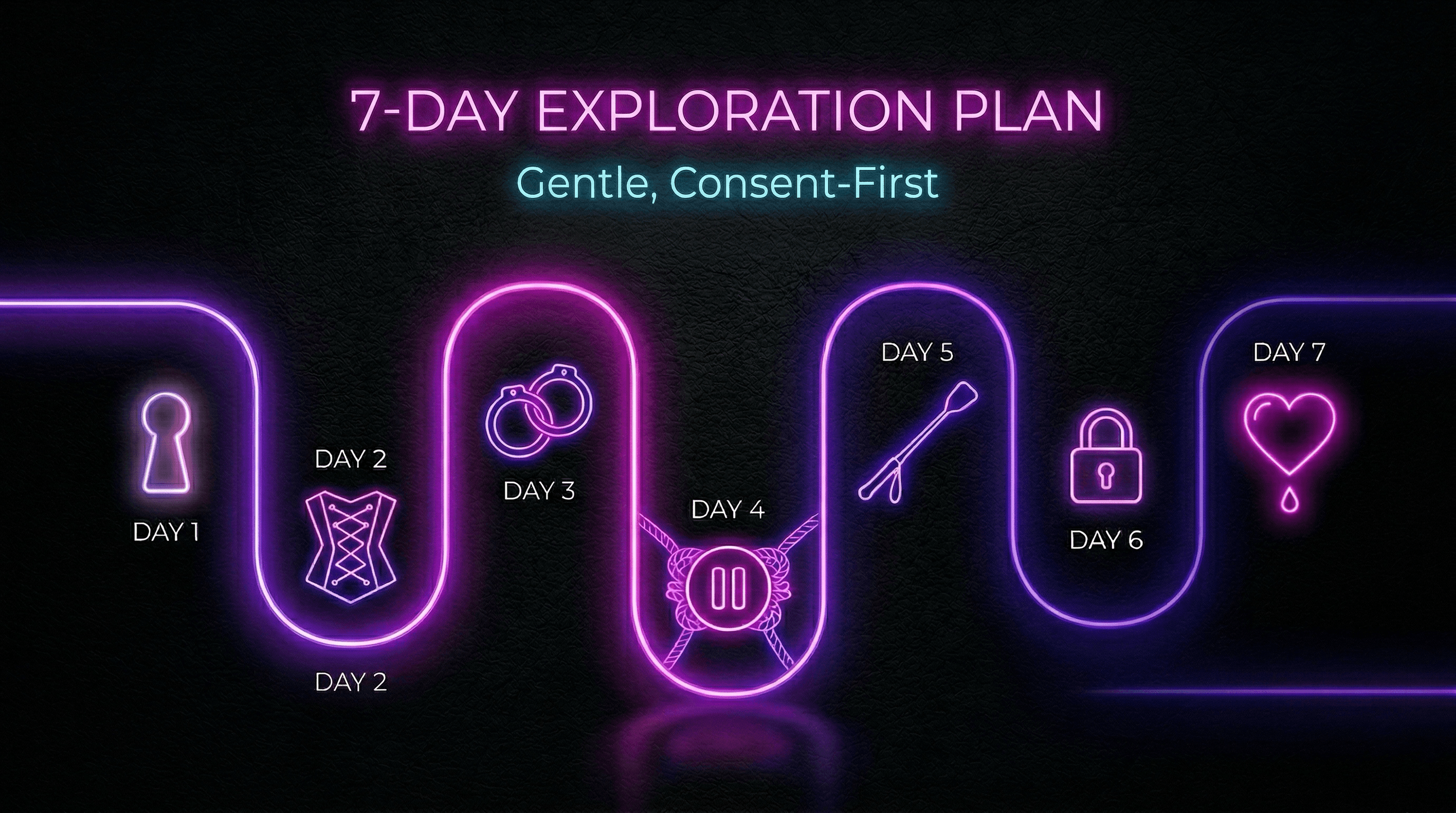
Find your best starting intensity
If you’ve ever wondered “how intense should I go?” you’re already doing the most important thing: planning for a good experience, not just a bold one. Intensity is not a “bravery test.” It’s a pacing tool—a way to match your nervous system, your curiosity, and your trust level with the kind of experience you’ll actually enjoy.
This guide helps you choose Light vs Moderate vs Full in a beginner-safe, non-explicit way, with a 60-second self-check and simple scripts for communicating your pace.
TL;DR
- Start lower than you think. You can always go up; going down mid-session is harder if you’re already overwhelmed.
- Intensity is pacing, not courage. It’s about comfort, clarity, and adjustability—not proving anything.
- Use a ladder: start → adjust → stop. If you can’t comfortably stop, you’re not truly in control of the intensity.
Intensity is a pacing tool, not a “bravery test”
Most beginner mismatch comes from one of two situations:
- Someone picks intensity based on what sounds exciting in theory, then realizes their body wants something slower and simpler in practice.
- Someone under-communicates intensity, hoping “we’ll figure it out,” and then both people interpret signals differently.
A better framing is this:
Intensity = how much stimulation (mental + emotional + novelty) you’re inviting at once.
It can include:
- Speed (how quickly things progress)
- Novelty (how unfamiliar the experience feels)
- Complexity (how many moving parts you’re managing: roles, rules, structure, etc.)
- Emotional charge (how intense the feelings feel in the moment)
- Aftereffects (how much you’ll want recovery time afterward)
When you treat intensity as pacing, you can choose it the same way you’d choose a workout plan, a travel itinerary, or a first day at a new job: start simple, learn your baseline, then layer in options intentionally.
Light, Moderate, Full: beginner-safe definitions
Below are three intensity levels described without explicit acts—focused instead on what they feel like, who they tend to work for, and the most common beginner mistakes.
Light intensity
What it feels like
- Calm, curious, and low-pressure
- Easy to pause and talk without “breaking the moment”
- More like exploring a vibe than running a “scenario”
Who it’s for
- First-timers or anyone returning after a long gap
- People who get overwhelmed by novelty, performance pressure, or uncertainty
- Partners still learning how to read each other’s “yes,” “no,” and “maybe”
Common beginner mistakes
- Skipping the check-in because it feels “too formal,” then guessing what the other person wants
- Trying to make it perfect instead of treating it like a low-stakes experiment
- Going faster than planned because nerves mimic excitement
A helpful mindset
Light is not “less real.” Light is how you build accuracy—so future intensity is earned, not forced.
Moderate intensity
What it feels like
- Clearly structured, more immersive
- Still conversational when needed, but with more “flow”
- More emotional charge and engagement than Light
Who it’s for
- People who’ve tried Light a few times and felt steady
- Partners with good baseline communication and trust
- Anyone who wants a stronger sense of “container” (clear start, clear end)
Common beginner mistakes
- Adding too many elements at once (structure + novelty + speed), which spikes overwhelm
- Assuming shared definitions (“moderate” can mean very different things to different people)
- Not planning recovery (time to decompress and reconnect)
A helpful mindset
Moderate works best when you’re confident in your ability to slow down—not just your desire to speed up.
Full intensity
What it feels like
- Highly immersive, emotionally potent
- More “in the experience” than talking about it
- Often requires stronger structure, clearer boundaries, and more aftercare/recovery
Who it’s for
- People who already know their baseline responses to intensity
- Partners who can communicate clearly before and after, and can reliably pause/stop during
- Anyone who wants depth—but is also willing to build the foundation for it
Common beginner mistakes
- Treating Full as the “goal.” That leads to rushing and regret.
- Confusing adrenaline with alignment. A rush can feel exciting and still be too much.
- Not defining a stop plan. If you don’t know how you’ll pause, you’re not choosing intensity—you’re gambling on it.
A helpful mindset
Full should be repeatable. If you can’t imagine doing it again comfortably, it’s probably too much right now.
The 60-second self-check (10 yes/no questions)
Answer quickly with your first instinct. No overthinking.
Score yourself: count how many “YES” answers you have.
- I can say “pause” out loud without feeling embarrassed.
- I can name at least one hard no and one maybe right now.
- I tend to feel calm when I try new things, not flooded.
- I sleep reasonably well and feel generally steady lately.
- I trust my partner to stop immediately if I ask.
- I trust myself to stop immediately if I need to.
- I recover quickly after emotionally intense moments.
- I prefer structure (a clear start/end) over improvising everything.
- I’m okay with checking in during the experience without feeling it ruins the mood.
- If something felt “too much,” I’d talk about it the next day rather than avoid it.
Suggested starting level (no medical claims—just a practical heuristic):
- 0–3 YES → Start Light. Build comfort, language, and repeatability first.
- 4–7 YES → Start Moderate. You likely want structure, but keep adjustability.
- 8–10 YES → Consider Moderate with a path to Full. Even with high readiness, starting Moderate lets you validate in real life before scaling.
If you want this decision prefilled for you—based on your archetype, pacing style, and communication preferences—use the quiz:
Find your best starting intensity → Take the BDSM Archetype Quiz
The escalation ladder principle: start → adjust → stop
Here’s the simplest way to avoid regret:
1) Start lower than your fantasy
Your fantasy is allowed to be big. Your starting pace should be easy to control.
Pick a starting level you could repeat comfortably—even on a slightly stressful day.
2) Adjust in small steps
Use “one-change-at-a-time” adjustments:
- Increase speed or structure or emotional charge—not all three at once.
- Pause after each step and check: still a yes? still steady?
3) Stop without penalty
Stopping is not a failure. It is competence.
A good stop plan includes:
- A simple pause word (“pause” is enough)
- A reset action (slow down, sit up, breathe, get water)
- A no-blame line (“Thanks for telling me. We’re good.”)
If stopping feels loaded, intensity becomes risky—not because the experience is “dangerous,” but because your nervous system can’t relax.
How to communicate your intensity (3 scripts)
Use these word-for-word if you want. They’re intentionally plain and beginner-safe.
Script 1: First-time alignment (simple and calm)
“Can we choose an intensity level before we start—Light, Moderate, or Full? I’d like to start Light today so we can learn what feels good and keep it easy to pause and talk.”
Script 2: Boundary + flexibility (clear but not rigid)
“I’m a Light-to-Moderate person right now. If anything feels too fast or too intense, I’ll say ‘pause’ and we’ll slow down. If things feel steady, we can gently increase—one step at a time.”
Script 3: After a mismatch (repair without shame)
“I realized the intensity was higher than my body wanted. It’s not about you—it’s about pacing. Next time I want to start lighter and build up more gradually. What would help you feel good and connected during that?”
A useful add-on line for any script: “Can we agree that ‘pause’ always works, no questions asked?”
Checklist: Before you start (8–12 items)
Use this as a quick, practical pre-flight check.
- [ ] We picked a starting intensity: Light / Moderate / Full
- [ ] We agreed on a pause word (“pause” works)
- [ ] We named one “hard no” each (no justification required)
- [ ] We named one “maybe/depends” each (conditions matter)
- [ ] We set a rough time container (e.g., “20–40 minutes, then check in”)
- [ ] We agreed how to communicate adjustments (“slower,” “softer,” “less structure,” “more structure”)
- [ ] We made a simple stop plan: pause → reset → decide
- [ ] We removed obvious distractions (phones, interruptions, rushing)
- [ ] We agreed on a light reconnection moment afterward (water, cuddle, talk, quiet)
- [ ] We’re not using intensity to fix a conflict or prove something
- [ ] We’re both comfortable with “not today” being a complete answer
- [ ] We’re willing to debrief later with kindness, not a scorecard
FAQ
1) What if we want different intensity levels?
Start with the lower level. A shared experience only works if both nervous systems feel safe. If one person wants Full and the other wants Light, treat that as useful information—not a problem to push through. Build a ladder together.
2) Does starting Light mean I’m “not into it”?
No. Starting Light often means you’re smart about calibration. Many people enjoy higher intensity more when they’ve built accurate pacing, trust, and language first.
3) How do we avoid drifting into higher intensity by accident?
Use a midpoint check-in (“Are we still at Light/Moderate?”), and agree to change only one variable at a time. If things accelerate, pause and reset. You’re not “ruining it”—you’re steering.
Internal link suggestions
- Aftercare Basics: How to Feel Close (Not Weird) After Trying Something New
- Privacy by Design: How to Explore Without Oversharing
Find your best starting intensity
If you take one thing from this guide, make it this: you don’t need to “go big” to go deep. The fastest way to enjoy intensity long-term is to start with a level you can repeat confidently, then scale gradually.